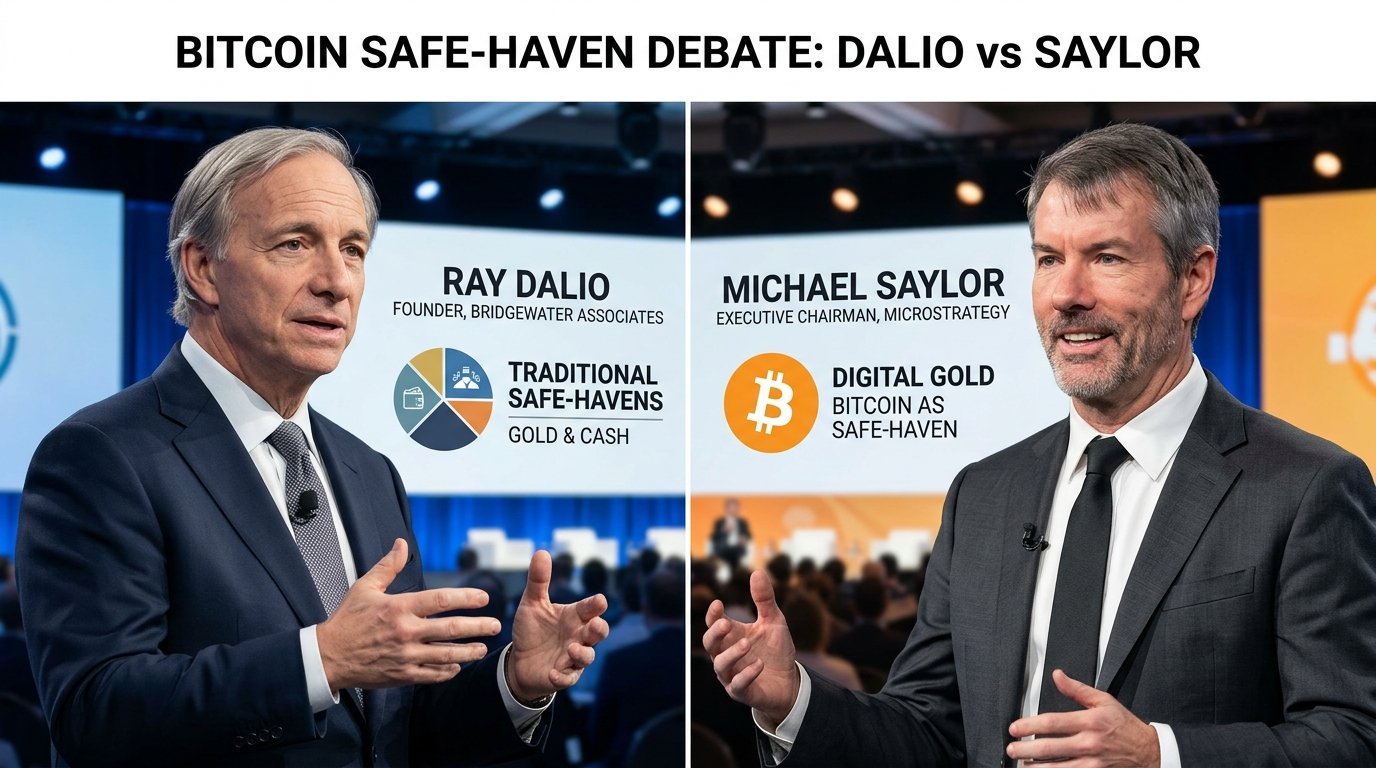
The debate surrounding Bitcoin’s position in the global financial system has intensified once again after billionaire investor Ray Dalio publicly questioned whether Bitcoin can truly function as a safe-haven asset during periods of economic instability. His remarks quickly sparked reactions across the cryptocurrency industry, most notably from Michael Saylor, one of Bitcoin’s most vocal supporters and corporate adopters. The exchange has reignited broader discussions about Bitcoin’s long-term role in finance, especially as investors continue searching for protection against inflation, currency devaluation, and geopolitical uncertainty.
The argument over whether Bitcoin deserves the label of digital gold is not new. For years, supporters have claimed that Bitcoin’s decentralized nature, limited supply, and independence from central banks make it an ideal hedge against economic turmoil. Critics, however, argue that Bitcoin’s volatility prevents it from behaving like traditional safe-haven assets such as gold or government bonds.
As institutional adoption of cryptocurrencies grows and governments continue reshaping monetary policy, the comments from Ray Dalio and Michael Saylor carry significant weight. Both figures have massive influence in global finance, and their opposing views highlight the ongoing uncertainty surrounding Bitcoin’s true identity. Is Bitcoin a speculative technology asset, or is it evolving into a reliable store of value capable of competing with gold?
This article explores the details behind the disagreement, examines Bitcoin’s safe-haven narrative, analyzes the arguments from both sides, and looks at what the debate means for investors and the broader crypto market.
Ray Dalio Raises Doubts About Bitcoin as a Safe Haven
Ray Dalio has long been regarded as one of the most respected macro investors in the world. Known for his deep understanding of debt cycles, inflation, and global markets, Dalio’s opinions often influence institutional investors. Although he has previously acknowledged Bitcoin as an interesting alternative asset, his latest comments suggest he remains skeptical about its ability to function as a dependable safe haven.
Dalio questioned whether Bitcoin can truly preserve wealth during times of market stress. His concerns mainly revolve around Bitcoin’s price volatility and correlation with risk assets. In several major market downturns, Bitcoin has fallen alongside equities rather than acting as a stabilizing asset. For critics like Dalio, this behavior undermines the argument that Bitcoin is comparable to gold.
The billionaire investor also highlighted concerns about regulatory uncertainty. Governments across the world continue debating how cryptocurrencies should be taxed, monitored, and controlled. Dalio warned that state intervention could limit Bitcoin’s effectiveness as an independent financial refuge. From his perspective, an asset cannot fully serve as a safe haven if it remains vulnerable to changing government policies and regulatory crackdowns.
Another issue raised by Dalio involves Bitcoin’s relatively short history. Gold has been trusted as a store of value for thousands of years, while Bitcoin has existed for only a little over a decade. Dalio argues that investors should be cautious before assigning Bitcoin the same level of trust and stability traditionally associated with precious metals.
Despite his skepticism, Dalio did not completely dismiss Bitcoin. He acknowledged that the cryptocurrency has unique characteristics and continues attracting global demand. However, he emphasized that Bitcoin still faces significant hurdles before it can reliably function as a safe-haven asset during major economic crises.
Michael Saylor Defends Bitcoin’s Digital Gold Narrative
Michael Saylor responded forcefully to Dalio’s remarks, defending Bitcoin as one of the most important financial innovations of the modern era. Saylor has become synonymous with corporate Bitcoin adoption after transforming his company into one of the largest institutional holders of Bitcoin globally.
For Saylor, Bitcoin’s value lies precisely in the features that distinguish it from traditional financial assets. He argues that Bitcoin’s fixed supply of 21 million coins creates scarcity that cannot be manipulated by governments or central banks. In his view, this makes Bitcoin superior to fiat currencies, which are vulnerable to inflation through unlimited money printing.
Saylor also pointed out that Bitcoin’s volatility should not be confused with weakness. According to him, all emerging technologies experience volatility during adoption phases. He believes Bitcoin is still in the early stages of global monetization and that long-term holders have consistently benefited despite short-term price swings.
One of Saylor’s strongest arguments centers on monetary debasement. As central banks continue expanding balance sheets and governments accumulate massive debt, Saylor believes investors will increasingly seek assets that cannot be inflated away. He sees Bitcoin as the ultimate hedge against currency depreciation and fiscal mismanagement.
The Strategy chairman also rejected the comparison between Bitcoin and traditional speculative assets. While tech stocks depend on corporate performance and economic growth, Bitcoin operates independently of earnings reports, management decisions, or national borders. Saylor argues that Bitcoin represents a completely new form of monetary network designed for the digital age.
For many Bitcoin supporters, Saylor’s response reinforced the belief that Bitcoin’s role as a store of value will strengthen over time as adoption expands and market maturity improves.
Understanding the Safe-Haven Asset Debate
The disagreement between Dalio and Saylor reflects a larger question facing modern finance: what exactly qualifies as a safe-haven asset in today’s economic environment?
Traditionally, safe-haven assets are investments expected to retain or increase value during periods of economic uncertainty. Gold has historically filled this role because it is scarce, durable, and widely accepted across civilizations. Government bonds from stable economies have also been considered safe havens due to their perceived reliability.
Bitcoin supporters argue that the cryptocurrency possesses many of the same characteristics that made gold valuable for centuries. Bitcoin is decentralized, difficult to confiscate, globally transferable, and mathematically scarce. These qualities have fueled the narrative that Bitcoin is becoming digital gold.
However, critics note that Bitcoin often behaves differently from traditional safe havens during market panics. Instead of rising while other assets fall, Bitcoin has at times experienced sharp declines alongside stocks and other risk-sensitive investments. This raises questions about whether investors truly view Bitcoin as a protective asset or merely as a speculative opportunity.
Another challenge involves market maturity. Gold benefits from centuries of trust, deep liquidity, and relatively stable demand patterns. Bitcoin, while growing rapidly, still remains vulnerable to sudden sentiment shifts, regulatory developments, and speculative trading activity.
The safe-haven debate has become even more important as inflation concerns continue affecting economies worldwide. Investors are actively searching for assets capable of preserving purchasing power in an environment characterized by rising debt levels and aggressive monetary policies.
Bitcoin’s Relationship With Inflation and Monetary Policy
One reason Bitcoin remains at the center of financial discussions is its perceived ability to hedge against inflation. Central banks across the globe dramatically expanded money supply in recent years, raising fears about long-term currency devaluation. Bitcoin advocates argue that the cryptocurrency offers protection because its supply is permanently capped.
Unlike fiat currencies controlled by governments, Bitcoin follows a transparent issuance schedule embedded in its code. New Bitcoin creation slows over time through the halving process, reinforcing its scarcity. Supporters claim this predictable supply model makes Bitcoin attractive during periods of loose monetary policy.
Ray Dalio has repeatedly warned about the dangers of excessive debt and currency debasement. Yet he remains unconvinced that Bitcoin alone can serve as the ultimate inflation hedge. Dalio has historically favored diversified portfolios containing assets like gold, commodities, and inflation-linked investments.
Meanwhile, Michael Saylor believes Bitcoin represents the most efficient response to modern monetary expansion. He frequently describes cash as a “melting ice cube,” arguing that inflation steadily destroys purchasing power. In contrast, he sees Bitcoin as a long-term preservation vehicle capable of protecting wealth across generations.
The divergence between their views highlights a key issue in financial markets. Investors are still determining whether Bitcoin’s scarcity outweighs its volatility. While Bitcoin has generated extraordinary long-term returns, its short-term price fluctuations remain a barrier for more conservative investors seeking stability.
Institutional Adoption Continues to Shape Bitcoin’s Image
Institutional involvement has dramatically transformed Bitcoin’s reputation over the last several years. Major asset managers, publicly traded companies, hedge funds, and financial institutions have entered the crypto market, lending credibility to Bitcoin as a legitimate asset class.
The approval of spot Bitcoin exchange-traded funds in several markets further accelerated mainstream adoption. Institutional investors who were previously hesitant to directly hold cryptocurrencies can now gain exposure through regulated financial products. This development has strengthened arguments that Bitcoin is gradually integrating into the traditional financial system.
Michael Saylor played a major role in promoting corporate Bitcoin adoption. Under his leadership, Strategy accumulated billions of dollars worth of Bitcoin as part of its treasury strategy. His aggressive stance inspired other companies and institutional investors to consider Bitcoin as a reserve asset.
However, institutional participation has also created new criticisms. Some analysts argue that growing institutional ownership increases Bitcoin’s correlation with broader financial markets. If large funds treat Bitcoin similarly to technology stocks or risk assets, its behavior during crises may continue resembling speculative investments rather than safe havens.
This evolving market structure partly explains why the safe-haven debate remains unresolved. Bitcoin simultaneously exhibits qualities of both a long-term store of value and a high-risk investment, depending on market conditions and investor sentiment.
Can Bitcoin Replace Gold in the Future?
The comparison between Bitcoin and gold remains one of the most controversial topics in finance. Bitcoin enthusiasts often argue that younger generations prefer digital assets over physical commodities. They believe Bitcoin’s portability, divisibility, and borderless nature make it more practical than gold in a digital economy.
Gold supporters, however, emphasize the metal’s historical resilience. Gold has survived wars, economic collapses, and political upheavals for thousands of years. Bitcoin, by comparison, still faces technological, regulatory, and adoption-related uncertainties.
Ray Dalio has consistently maintained a preference for gold over Bitcoin as a proven store of value. He views gold as a time-tested hedge that central banks and governments continue holding as reserves. From his perspective, gold’s historical track record provides reassurance that Bitcoin cannot yet match.
Michael Saylor takes the opposite position, arguing that Bitcoin’s digital characteristics make it superior to gold for the modern world. He frequently points out that Bitcoin is easier to transport, verify, and store compared to physical bullion. Saylor believes these advantages will eventually allow Bitcoin to absorb value traditionally stored in gold.
The future relationship between Bitcoin and gold may not necessarily involve direct replacement. Some analysts believe both assets could coexist as alternative stores of value, serving different investor preferences and risk tolerances.
Market Reactions to the Dalio and Saylor Exchange

The public disagreement between Dalio and Saylor quickly attracted attention across financial markets and social media. Cryptocurrency supporters largely sided with Saylor, arguing that Bitcoin’s long-term trajectory continues proving its value proposition despite short-term volatility.
Traditional investors and skeptics, however, viewed Dalio’s comments as a reminder that Bitcoin still faces serious credibility challenges before achieving universal acceptance as a safe haven.
Market analysts noted that the debate itself reflects Bitcoin’s growing importance in global finance. A decade ago, discussions involving Bitcoin were largely confined to niche crypto communities. Today, major institutional figures openly debate its role alongside gold, bonds, and reserve currencies.
The exchange also highlighted generational differences in investment philosophy. Younger investors often show greater openness toward digital assets and decentralized finance, while more traditional investors tend to favor established stores of value.
Despite the differing opinions, both Dalio and Saylor agree on one important point: the global financial system is undergoing profound changes. Rising debt levels, inflation concerns, technological innovation, and geopolitical tensions are forcing investors to rethink traditional assumptions about money and wealth preservation.
The Future of Bitcoin as a Safe-Haven Asset
Bitcoin’s journey toward safe-haven status remains incomplete. The cryptocurrency continues evolving as adoption increases, infrastructure improves, and regulatory clarity develops. Whether Bitcoin eventually achieves the same level of trust as gold will depend on several critical factors.
Market stability is likely to play a major role. If Bitcoin volatility decreases over time while maintaining strong long-term performance, institutional confidence could strengthen significantly. Greater liquidity and broader ownership may help reduce extreme price swings that currently concern conservative investors.
Regulatory developments will also shape Bitcoin’s future. Clear and balanced regulations could encourage wider adoption by reducing uncertainty for institutional participants. On the other hand, aggressive restrictions could limit Bitcoin’s appeal as an independent financial alternative.
Technological resilience remains another important consideration. Bitcoin’s network security and decentralization have so far proven remarkably durable, but long-term trust will depend on continued reliability and resistance to censorship.
Perhaps most importantly, investor perception will determine whether Bitcoin ultimately becomes a true safe haven. Financial assets derive value not only from technical characteristics but also from collective belief and market psychology. As more individuals, institutions, and even governments recognize Bitcoin as a legitimate store of value, its role in the financial system may continue expanding.
Conclusion
The clash between Ray Dalio and Michael Saylor over Bitcoin’s safe-haven status reflects one of the most significant debates in modern finance. Dalio’s skepticism centers on volatility, regulation, and Bitcoin’s limited historical track record, while Saylor sees Bitcoin as the ultimate protection against inflation and monetary debasement.
The truth may lie somewhere in between. Bitcoin has undeniably evolved from a fringe experiment into a globally recognized financial asset attracting institutional attention and mainstream adoption. Yet it also remains highly volatile and deeply influenced by market sentiment.
As economic uncertainty continues shaping global markets, the discussion around Bitcoin’s role as digital gold is unlikely to fade anytime soon. Whether Bitcoin eventually secures a permanent place alongside traditional safe-haven assets will depend on its ability to mature, stabilize, and maintain trust across generations of investors.
For now, the Dalio versus Saylor debate serves as a reminder that Bitcoin’s story is still being written, and the future of finance may ultimately include both traditional and digital stores of value.